





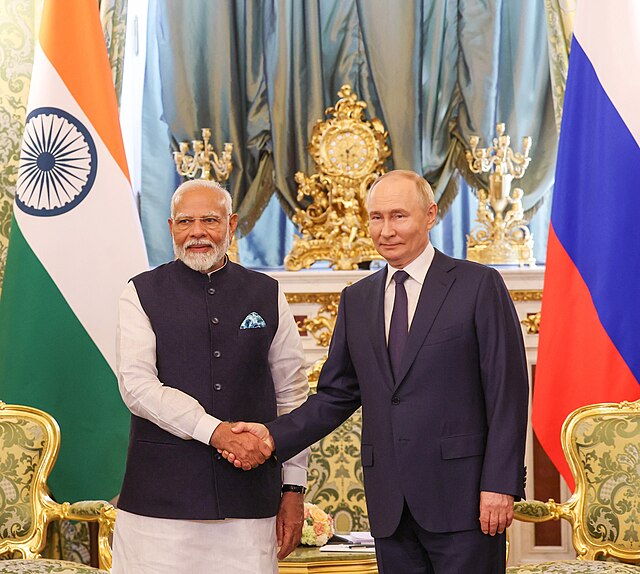
Image by Prime Minister's Office
Please Follow us on Gab, Minds, Telegram, Rumble, GETTR, Truth Social, X , Youtube
The sudden tightening of American-Indian relations in the context of the tariffs imposed by US President Donald Trump and his harsh words about that country, such as the one about India's "dead economy" and about the intention to arm Pakistan with American weapons, resulted in very sharp political and media anti-American reactions in India, but also worked to homogenize the society there, which is otherwise politically quite divided.
‘NO AD’ subscription for CDM! Sign up here and support real investigative journalism and help save the republic!
One of the demonstrative moves of India's dissatisfaction was the previous arrival in Moscow of Prime Minister Narendra Modi's national security advisor Ajit Doval, on a visit aimed at strengthening India's defense and energy ties with Russia, the procurement of new batteries for the modern Russian S-400 anti-aircraft system, as well as the possibility of buying Russian 5th generation Su-57 aircraft. Foreign Minister Subrahmanyam Jaishankar also visited Russia on August 27 and 28. Putin is coming on an official visit to India at the end of the year.
India is a traditional large importer of Russian (previously Soviet) weapons, which make up the bulk of the country's classic armaments. However, in the last decade, India has increasingly turned to the West - the USA, Israel, France - for the procurement of modern and sophisticated weapons. However, only Russia was always ready to share its technological know-how with India, in addition to weapons, by which Russia directly contributed to India's technological development.
India does not hide that its primary goal in entering into military-technical agreements is the acquisition of technological knowledge and the consequent production of these imported types of weapons in its manufacturing companies (the best example is India's famous BrahMos missile made using Russian technology and in cooperation with Russian designers). Because of this, also because of high prices and alleged technical problems, andnot allowing India to make technological changes in accordance with its needs, which is allowed only to Israel and perhaps a few other close American allies, India is now giving up on the purchase of the famous and globally popular American aircraft of the 5th generation F-35.
Take for example Russia's new R-77M active radar-guided air-to-air missile that provides a revolutionary improvement in capability, with a range of 200 kilometers that far exceeds the previous R-77-1 missile, is said to use an AESA radar in its guidance head for greater resistance to jamming and a longer target lock-on range. It is also said that it use active phased array technology to give the missile a more complete and wide-angle image of the target, making it much more difficult to avoid even fighter-sized targets that are easy to maneuver.
The R-77M is expected to significantly increase foreign interest in Russian combat aircraft and will be offered to customers for modern '4+ generation' and fifth generation Russian combat aircraft to improve their air-to-air capabilities.
Some of the leading potential customers for the missiles will probably include India but also Kazakhstan, Belarus and Algeria to improve their Su-30SM, MKI and MKA fighters, as well as Egypt where the missile could have a transformative impact on the performance of their MiG-29M fighters.
The R-77M's ability to bridge the gap with the Chinese PL-15 make it particularly attractive to the Indian Air Force, as neighboring Pakistan has acquired a significant number of Chinese J-10C and JF-17 Block 3 fighters with the PL-15. The missiles would make India's Su-30MKI and MiG-29UPG fighters much more competitive against these threats, while India could seek to acquire technologies from the new Russian missile to improve its own Astra air-to-air missile program.
Conclusion
The Commander of the Indian Air Force, Amar Preet Singh, recently stated that in the armed conflict in May with Pakistan, India destroyed six Pakistani aircraft.
According to Singh, most of the Pakistani planes were shot down by Russian-made S-400 missiles.
``We have confirmation of the downing of five fighters and one large aircraft``, Singh said.
He stated that the larger aircraft could have been a reconnaissance plane, shot down from a distance of 300 kilometers. That's the highest number of planes ever shot down, Singh said. Plus, shooting down a plane at a distance of 300 km is also a world record for the effectiveness of air defense systems. These confirmations about the quality of Russian weapons show that India is preparing for a major military contract with Russia.
The poor results of the Indian army in the conflict with Pakistan, especially the French Rafale fighter jets, encouraged India to once again turn to Russia for help. Behind Pakistan stood the technological power of China, with which India is unable to cope, and we see that neither is France, so India is preparing a response with proven Russian weapon systems. It is precisely the fear of China and Chinese proxies that forces India to engage in strategic cooperation with Russia.



Proven Russian systems....proven failures in real combat in Ukraine. India just playing their multi polar world games. Russia is desperate and willing to sell their souls right now and India is not after the best regardless.