




Please follow us on Truth Social, X, YouTube, Minds, Telegram, Rumble, GETTR, Gab, Instagram
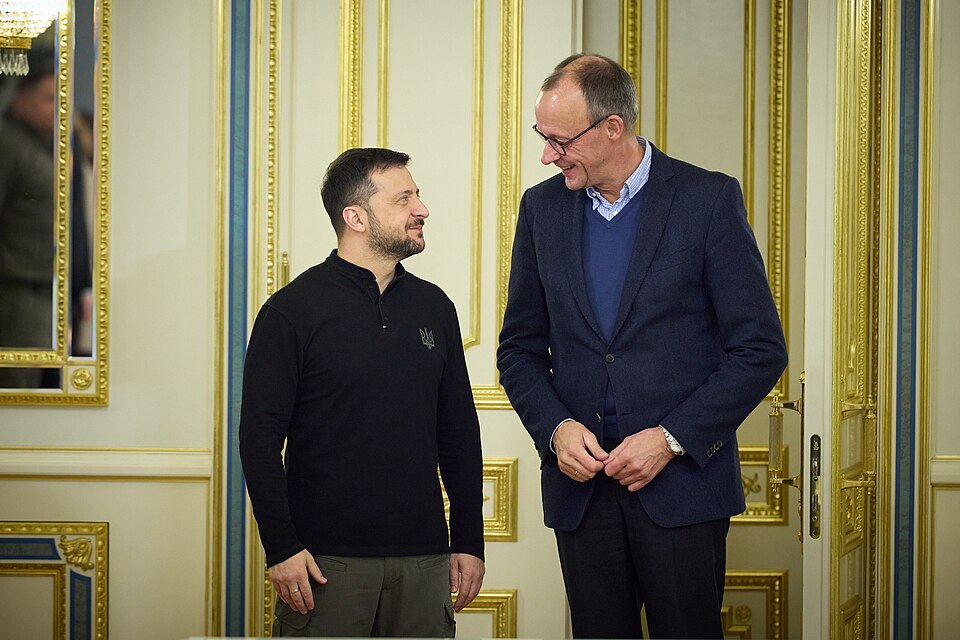
German Chancellor Friedrich Merz arrived in Kyiv on 4 October 2026 by special train, as air-raid sirens and explosions sounded over the capital, and used the trip to lock in another round of weapons, money, and industrial cooperation rather than any concrete path to a ceasefire.
Berlin’s package, as described by German officials to Reuters, is straightforward. Germany will release €1 billion in military aid already budgeted and €350 million for repairs to Ukraine’s energy system, while finalising a joint production deal covering drones and related systems. Merz travelled with Economy Minister Katherina Reiche and executives from defence and energy firms, including companies tied to interceptor drones and longer-range weapons.
The visit was not a diplomatic probe. It was an arms-and-industry mission staged under fire.
Merz’s own framing left little room for de-escalation. “If Russia is not stopped, it will turn its war machine against us sooner or later,” he said on arrival, according to German reporting of the trip. He told President Volodymyr Zelenskiy that Ukraine could continue to count on German help. That is the logic of indefinite support: Russian power must be worn down in Ukraine, or it will eventually be turned on Europe, so the flow of interceptors, long-range systems with ranges above 1,000 kilometres, and repair money cannot be allowed to stop.
Winter attacks on power plants are treated as a reason to spend more, not as a reason to force a settlement before the heating season.
The drone deal is the clearest sign of how Berlin now thinks about the war. Cooperation is no longer limited to deliveries from German stocks. It is joint production of interceptors against Russia’s jet-powered attack drones, plus work on weapons Ukraine can use to hit logistics and targets deep inside Russia. That binds German industry to the battlefield. Once factories, joint ventures, and order books are built around a continuing fight, a pause becomes a commercial and political problem as well as a military one.
Merz has already argued that supporting Ukraine also strengthens Germany’s own defence industry and technology base. Sustaining the war and sustaining that industry now point in the same direction.
Officials can still say Germany is open to talks. Reuters reported Merz repeating a call for Vladimir Putin to end what he called a senseless war, and saying Berlin was ready to discuss an end to the fighting so long as attacks on civilians stopped. Those lines do not change the substance of the visit. No new negotiation format was announced. No condition was attached to the €1 billion that would push Kyiv toward a compromise. The money and the production plans were released while Russian strikes were underway, and while Merz warned that failure to stop Moscow would endanger Europe itself.
Readiness for talks, on those terms, is compatible with arming one side for as long as it takes.
The political context in Germany makes the choice sharper. Merz has pledged to keep support high even as the Russia-friendly Alternative für Deutschland gains ground. The Kyiv trip, his first bilateral visit as chancellor, answers that pressure with more aid and a public argument that European security depends on the war continuing until Russia is stopped. Energy repairs address the damage; they do not address the decision to keep the conflict financed.
Anti-corruption lectures to Kyiv, which Merz is also expected to deliver, are about making the client presentable to European partners, not about shortening the war.
Taken together, the surprise arrival, the military tranche, the energy cheque, the drone and long-range production plans, and the warning about Russia’s “war machine” amount to a policy of continuation. Merz did not go to Kyiv to test an off-ramp. He went to tell Zelenskiy the tap stays open, and to tie German firms more tightly to a fight he presents as existential for Europe. That is what continuing the war at all costs looks like in practice: another billion, another production line, and no date on which either is meant to end.
Sources for the visit, figures, and quotes include Reuters reporting from Kyiv on 4 October 2026 and contemporaneous accounts from DW, Politico, and Tagesschau. Merz’s public call for Putin to stop the war is part of that record; the article’s claim is that the measures he announced still commit Berlin to prolonging the fighting.