




Guest post by Dr. Samuel Sako
President Donald Trump has never been one to shy away from unconventional methods. His direct, often disruptive leadership style has yielded results that conventional diplomacy has failed to deliver. And though President Trump’s plate is full, history offers no pause—Africa waits for no one, and the window of opportunity to shape its future is closing fast.
The world should give credit to President Trump for his unyielding commitment to getting results and delivering on his promises. He is a unique Commander-in-Chief, and his “out of the box” methods and style have brought great progress towards reducing global chaos. The President would be wise to use these techniques in Africa to head off the loss of the region to China, Russia or Islamist radicalism.
There is still time.
One example of the growing threat is in the Sahel, where trouble is brewing.
JNIM, along with the rival Islamic State-Sahel Province, has turned the region into an epicenter of Islamist insurgency. The Institute for Economics & Peace’s annual index last year found 51 percent of terrorism deaths worldwide were in the Sahel, a vast, tumultuous region south of the Sahara that spans the breadth of Africa. The chaos ravaging the region has helped military officers seize power in coups — vowing to break with the West and restore calm, writes The Washington Post.
But in most countries the security situation has only gotten worse. In 2024, Burkina Faso ranked as the nation most affected by terrorist violence for a second straight year, and Niger saw the largest increase in terrorism-related deaths globally. In a sign of JNIM’s southward spread, Togo reported the most terrorist attacks it its history; Benin has reported nearly as many deaths in the first three months of this year than in all of 2024.
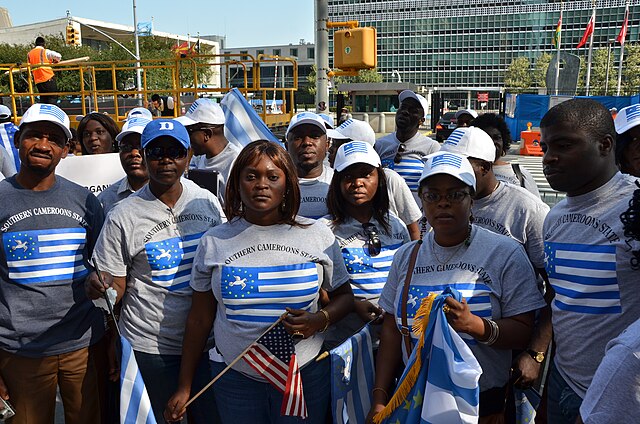
Another region that deserves attention from Team Trump is Southern Cameroons.
.
For nearly a decade, the government of Cameroon has repeatedly failed the United States by neglecting critical security concerns in the area. The government’s inability—or unwillingness—to address key threats such as Boko Haram in the north and cross-border incursions by Central African militias to the east has contributed to growing instability. According to the U.S. Holocaust Memorial Museum, the Cameroonian military’s scorched-earth campaign against the English-speaking population in the Northwest and Southwest regions – collectively known as Southern Cameroons – amounts to genocide (2020)
Paul Biya, Africa’s longest-ruling head of state, has been in power since 1982 and is widely believed to be incapacitated. His government has maintained control through rampant corruption, election fraud, constitutional manipulation and violent suppression of the opposition in my first home. Biya spends extended periods of time in Europe while his administration enforces policies that primarily benefit his small Beti-Bulu clan, crippling private enterprises—especially in Southern Cameroons.
The U.S. must recognize that Cameroon is no longer a stable or reliable partner in Central Africa. The waning influence of France, coupled with growing Chinese and Russian geopolitical opportunism, makes it clear that the status quo is no longer in America’s national interest—particularly in the Gulf of Guinea.
By directly engaging with Southern Cameroons leaders, like me, the U.S. can diversify its partnerships in the region, rather than relying solely on the failed Biya government. Southern Cameroons contributes over 60% of Cameroon’s GDP, and its location in the Gulf of Guinea makes it a natural bridge between West and Central Africa. Indeed, Southern Cameroons can serve as a critical U.S. ally, ensuring regional stability, economic prosperity, and a strong counterbalance to Chinese and Russian expansion.
As a Southern Cameroons diaspora leader in the United States, I recognize and appreciate President Trump's new style. I urge the President to think about Africa differently as well. Previous American administrations have lost Africa. The French previously had a major role but have stepped back from the Continent. This has left a vacuum that bad actors are using to take advantage, gain power, resources and influence, including ISIS.
Engaging African political organizations and leaders, not just heads of state, including Cameroon, and specifically the English speaking and pro-American Southern Cameroons presents a rare opportunity to create a unique diplomatic structure and non-traditional ways of doing business. We should think in new ways, as President Trump has done elsewhere to address the growing radical Islam problem that transcends borders in Africa.
This is a direct call to action: the United States must engage the leadership of Southern Cameroons and open strategic, high-level channels of communication. We stand ready to serve as a vital resource to the Trump administration in navigating and addressing the growing instability in Central Africa – instability exacerbated by a regime led by President Paul Biya, who is absent, incapacitated and dangerously out of touch, at the expense of U.S. interests. I can also help identify other allies and leaders from Southern Cameroons in the diaspora whom the U.S. can meet directly.
Cameroon was once a trusted U.S. partner, but that partnership was betrayed when American defense equipment and training were used to target our own people — instead of being used to combat Islamic terrorism, as intended.
Southern Cameroons is rich in untapped natural resources and economic opportunity. We certainly would be great hosts to the U.S. business community as well.
For Washington, engaging with Southern Cameroons should be seen as a decisive act of containment against the dangerous and rising tide of radical Islam in Africa.
Dr. Samuel Sako is President of the Government of Southern Cameroons in exile. He has lived in the United States on political asylum since 2010. Since 1992, Dr. Sako has been a political activist and human rights champion on behalf of the people of Southern Cameroons and their struggle for restoration and recognition. In 2019, he was elected president of the then Southern Cameroons Interim Government by an electoral college representing both the people of and major civil society organizations in all thirteen counties in Southern Cameroons.