





...the future belongs to those who show up...

Please Follow us on Truth Social, X , Youtube , Minds, Telegram, Rumble, GETTR, Gab
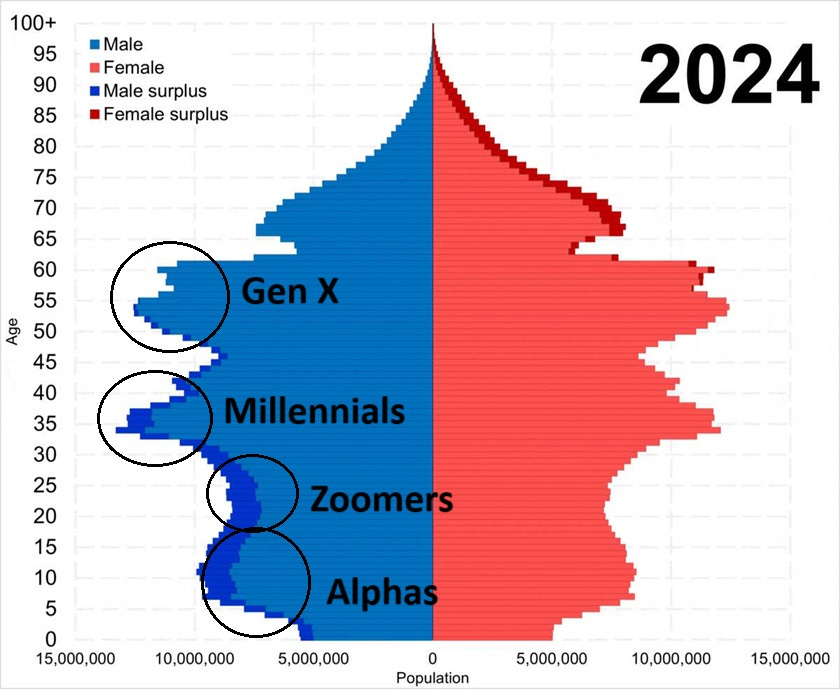
Of all the theories out there about if/when/where the People’s Republic of China may decide to claw back more territory they “lost” during their century of humiliation, there is one common thread that is there, but is not given the attention it deserves: demographics.
The demographic collapse we are all about to see over the next few decades will arrive in East Asia first, then Europe. The greatest impact on the globe will be in East Asia, simply by the numbers, if nothing else.
Demographics are one of those things you really cannot spin your way out of. You can’t catch up. A baby is born and reaches adulthood—or it does not. You can try to hide numbers and lie to your boss for just so long; eventually, the bodies simply will not be there.
In South Korea and Japan you have relatively transparent societies where decision makers and leaders can at least plan for what is coming, but for the largest nation in East Asia—and the U.S.A.’s greatest global competitor, that is not the case.
Our friend Stephen Green is tapping everyone on the shoulders about this.
“Last week, Beijing’s release of China’s national birth count for 2025 left demographers stunned,” Nicholas Eberstadt wrote for the New York Post on Saturday. “The national birth total plummeted by over 17% from 2024 to 2025,” a drop that is “almost never seen in stable modern societies.”
Stick a pin in that last part. I’ll come back to it shortly.
Eberstadt called the figures “only the latest readings from the astonishing birth crash that’s commenced under Xi Jinping’s rule: a drop by over half in just eight years that shows no sign as yet of abating.”
“The new birth figures imply that the total fertility rate [TFR] has finally fallen below one birth per woman,” 10 ironic years after Xi ended China’s notorious One Child Policy.
It’s a short list of countries with a TFR of less than one: South Korea, Taiwan, Ukraine, Singapore, Thailand, and now China.
…
Women must bear an average of 2.1 children for a population to remain steady. Anything above that, and a population grows. Anything less, and it slowly shrinks. At a TFR of 1.3, some experts hypothesize a nation enters the Low Fertility Trap, where each generation is roughly 50% smaller than the preceding generation — and that there's little hope of escape.
When a nation — like China in 2025 — goes under 1 TFR, they're in what some demographers call the Ultra-Low Crisis. That's when "Shrinkanomics" starts to kick in as the tax base grows ever smaller, schools close, and the healthcare system is overwhelmed by a massive elderly population supported by a tiny, dwindling workforce.
How are these numbers operationalized?
China isn't there yet, but absent one of those nearly impossible turnarounds, the country will lose roughly 200 million people by 2050 — a loss over-represented by children and the working-age population. By 2100, China's population (currently best-estimated at about 1.25 billion by Dr. Yi Fuxian of the University of Wisconsin-Madison) could drop to between 390 and 440 million souls.
Will the PRC really get old before it gets rich? Will it execute a last chance power drive while it has the surplus masses of young men to capture Taiwan and then the lost territories in Russia’s Far East? Will the social tensions to tend to the growing mass of elderly have a yet unexpected impact sooner more than later?
I have no idea. No one really does. In written history, absent apocalyptic war or plague, no society—much less entire continents—has experienced anything like what is about to happen as we approach mid-century. There’s no avoiding it. The correction needed was left behind in the bedrooms at the end of the previous century.
That comment about stability keeps popping up. What does an unstable nation of 1.25 billion souls look like? We may just find out.
Now, go make babies.





Well, the Bible does state to be fruitful and multiply but I have came to the conclusion that things don’t usually turn out the way you expect it to ! Humans are not smart enough to realize the long-term consequences of their actions, including the actions of governments. The world is too complicated.